On Tuesday, the Office of the United States Trade Representative issued its report in the Section 301 investigation of U.S. trading partners’ imposition and enforcement of prohibitions on the importation of goods produced with forced labor. USTR found that all sixty economies — which together account for 99.4% of shipments to the United States — either failed to enforce prohibitions, or failed to impose a prohibition in the first instance.
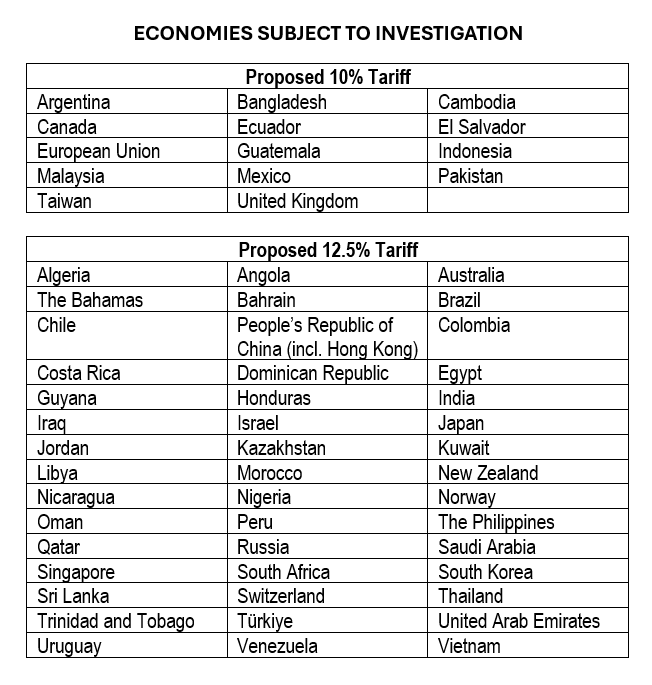
In response, as detailed in the table at the end of this Insight, USTR proposes tariffs of 10% or 12.5% on most products from these trading partners.
USTR has requested public comment and will conduct hearings, in which interested parties may wish to participate.
The Bottom Line: New Tariffs Proposed
Pursuant to this investigation under Section 301 of the Trade Act of 1974 (Section 301), USTR proposes to impose the following additional duties:
- A baseline of 12.5% ad valorem on all investigated countries except those identified as being closer to USTR’s standard for compliance, who would instead be subject to 10% ad valorem; and
- Lower tariffs on certain exports of textiles, in an amount tied to the quantity of U.S. textiles and cotton imported by the trading partner.
As the tariffs have not yet been finalized, no effective date has been set. Nevertheless, they are expected to be in place soon — likely after the expiration of the Section 122 tariffs in late July.
The fourteen economies to be subject to the 10% tariff are those that “impose a forced labor import prohibition” (Canada, Ecuador, the European Union, Indonesia, Mexico, and Pakistan); “have undertaken commitments in their respective Agreements on Reciprocal Trade regarding forced labor import prohibitions” (Argentina, Bangladesh, Cambodia, Ecuador, El Salvador, Guatemala, Indonesia, Malaysia, and Taiwan); and “imposed a partial regime with the effect of preventing the importation of certain forced labor goods” (the United Kingdom).
The particulars of the textile mechanism are not set forth in USTR’s Federal Register publication, and are intended to be a subject for public comment.
In addition, USTR proposes to exclude certain products, identified in Annex A to its notice, from the proposed additional Section 301 tariffs, including:
- all articles and parts of articles that are subject to Section 232 tariffs;
- USMCA-compliant goods of Canada or Mexico;
- textiles and apparel articles that enter duty-free as a good of Costa Rica, the Dominican Republic, El Salvador, Guatemala, Honduras, or Nicaragua under CAFTADR, and
- Informational materials (books).
Annex A then proceeds to list hundreds of subheadings to the Harmonized Tariff Schedule of the United States (HTSUS). For example, this list of subheading includes all articles that were excluded from IEEPA tariff coverage as “semiconductor” articles. While most of the proposed exclusions would apply broadly to any article properly classified under the relevant subheading, some are limited to, e.g., parts of civil aircraft classified within the subheading in question. Notably, all proposed exclusions are framed as applicable to all affected countries.
What Comes Next: Opportunity to Comment on Tariffs and Product Exclusions
USTR announced a second round of public comment, focused on the contours of its proposed action, specifically:
- Which products should be subject to the duties, including whether products should be retained or removed from the scope of the action, or whether products currently listed in Annex A should be added to the scope of the action;
- Whether products listed in Annex A are appropriately excluded;
- The level of the increase, if any, in the rate of duty;
- Whether different tariff rates should be applied to an economy where the economy has made a commitment to the United States to impose and enforce a forced labor import prohibition; has imposed a forced labor import prohibition; or has imposed a partial regime with the effect of preventing the importation of certain forced labor goods.
- Features of a textile mechanism, including the U.S. and foreign products to be covered, the relative market opportunities for each side, and the tariff rate (if any) to be applied to products subject to that mechanism, as well as whether a similar mechanism should apply to any other product or sector
Interested persons may request to appear at USTR’s hearing by June 22, 2026, and may submit written comments by July 6, 2026. The hearing is scheduled for July 7, 2026. Parties may also submit post-hearing rebuttal comments within five days of the final hearing.
How We Got Here:
From IEEPA to Section 301
In the wake of the U.S. Supreme Court’s February ruling that the International Emergency Economic Powers Act (IEEPA) does not confer tariff-making authority upon the President, the Trump Administration has pivoted to alternative authorities to implement tariffs. The first of these alternatives was the 10% tariffs imposed pursuant to Section 122 of the Trade Act of 1974, which a panel of the U.S. Court of International Trade recently held to be unlawful, and which are otherwise meant to expire within 150 days of introduction.
Soon thereafter, USTR announced several new investigations pursuant to Section 301, the same provision underpinning the longstanding tariff regime covering most products of the People’s Republic of China (PRC). One of these new investigations, initiated on March 11, 2026, concerns structural excess capacity and production in the manufacturing sectors of certain U.S. trading partners. The other new investigation, initiated on March 12, 2026, concerns U.S. trading partners’ practices with respect to their own importation of products made using forced labor.
A Fast Timeline
The statute provides USTR with twelve months to make findings and determine responsive action, if any, in Section 301 investigations, and generally requires consultation with the government of the foreign country involved, relevant interagency committees, and interested members of the public. Here, USTR held two days of public hearings at the end of April and consulted with the governments of 45 investigated countries, plus the European Union. For the remaining countries, USTR states they “did not accept the Trade Representative’s requests for consultations or were otherwise unable to participate.” Undertaking these procedures and issuing a report in less than three months is remarkably fast.
USTR’s Findings
USTR’s report concludes that 54 of the investigated economies do not prohibit the importation of goods made from forced labor in the first instance, and thus cannot effectively enforce a prohibition that does not exist. For the remaining six trading partners (Canada, Ecuador, the European Union, Indonesia, Mexico, and Pakistan), USTR concedes that a prohibition exists, but concludes that it is not effectively enforced. Having made these findings, USTR also reasons that these polices (or the lack thereof) are unreasonable within the meaning of Section 301 because they contravene universal norms against the use of forced labor. Finally, USTR finds that allowing goods produced using forced labor burdens or restricts U.S. commerce by lowering costs for competitor firms abroad, facilitating the circumvention of the U.S. prohibition against importing goods made using forced labor, and artificially reducing the competitiveness of U.S. exports into affected markets.
These substantive findings are not intended to be the direct subject of the upcoming comments and hearing.
Conclusion
The attorneys, licensed customs brokers, compliance professionals, economists, and trade specialists of Cassidy Levy Kent regularly assist companies in evaluating their supply chains to ensure compliant market access and adjust for tariff-related developments, including Section 301 tariffs, both mitigating burdens and taking advantage of opportunities. Businesses should be aware of the possible outcomes when planning or reviewing their supply chains.