
The Office of the U.S. Trade Representative (USTR) announced initial findings and proposed tariffs today in its Section 301 investigation of structural excess capacity and production (the Overcapacity Investigation) in fifteen countries and the European Union. USTR has not yet made determinations with respect to two countries: Mexico and Norway. For the rest, USTR has found unfair practices affecting the manufacturing sector and has proposed to impose additional tariffs on certain products.
USTR has proposed Section 301 tariffs ranging from 15% to 35% for certain imports from Bangladesh, Cambodia, the European Union, India, Indonesia, Japan, the Republic of Korea, Malaysia, Singapore, Switzerland, Taiwan, Thailand, and Vietnam. For certain of those countries, the Section 301 tariffs are inclusive of existing MFN tariffs; for others, the proposed tariff is in addition to MFN tariffs. These proposed tariffs are intended to represent total Section 301 tariff liability under the Overcapacity Investigation and the Forced Labor Section 301 investigation that was completed earlier this year.
For the People’s Republic of China, USTR has proposed a two-tier tariff framework with lower rates applicable to certain products identified by the U.S.-China Board of Trade.
USTR will accept comments on these proposals and hold a public hearing. Written comments and requests to appear are due by January 5, 2027.
Relationship Between Overcapacity and Forced Labor Investigations
USTR’s Overcapacity Investigation was originally launched in March 2026 alongside a companion investigation into U.S. trading partners’ imposition and enforcement of prohibitions on the importation of goods produced with forced labor (the Forced Labor Investigation). While results of the Forced Labor Investigation were issued several months ahead of the Overcapacity Investigation, findings in both investigations were issued well before the 12-month statutory deadline.
The acts, policies, and practices that are the subject of each investigation differ. However, there is some overlap in the focus on labor. Whereas the Forced Labor Investigation focuses on measures related to the importation of goods made from forced labor, the Overcapacity Investigation considers failure to protect domestic labor rights or adequately share the benefits of manufacturing growth with local workers as a contributing factor to the initial findings. The President imposed tariffs of 10 or 12.5 percent pursuant to the Forced Labor Section 301 investigation. As noted, the tariffs proposed by USTR today for most countries are intended to represent the total Section 301 liability pursuant to the Overcapacity Investigation and Forced Labor Investigation.
USTR’s Overcapacity Findings
In contrast to USTR’s approach to analyzing the dozens of countries subject to the Forced Labor Investigation, USTR has structured its determinations in the Overcapacity Investigation as specific to each country or the European Union. Individually, these determinations vary insofar as each focuses on country-specific industries of interest (e.g., apparel for Bangladesh, electronics for Thailand) and some identify a broader swathe of concerning industrial policies (e.g., China and Vietnam) than others (e.g., Switzerland).
While this reflects a degree of tailoring, the overarching legal standard and the major themes are generally consistent. These include government-driven policies favoring exports and growth in manufacturing capacity or production unrelated to trends in domestic demand, leading to an excess of the manufacturing capacity or production that USTR believes would otherwise exist under normal market conditions. USTR has found that the need for foreign markets—i.e., the United States—to absorb this production places a “burden” on U.S. commerce, a finding that is necessary to act under Section 301.
Interestingly, even with USTR’s country- or Union-specific analytical approach, China plays a cross-cutting role. USTR focuses on third countries’ economic links with China that allow Chinese inputs, capital, and investment to prop up excess capacity in third countries while supporting structural overcapacity within China.
With respect to Norway and Mexico, USTR has not yet published a negative finding as to either country. The deadline for concluding the Section 301 Overcapacity Investigation into these countries will lapse in March 2027, so it remains possible that USTR could reach findings with respect to one or both countries in the future.
Proposed Rates, Product Exclusions, Anti-Stacking
The table below summarizes USTR’s proposed rates for the countries for which it has announced findings in the Overcapacity Investigation. For most countries, USTR identifies various alternative scenarios—some worse, some better—which are summarized below as well.
The proposed tariff rates are structured to mitigate “stacking” in two ways: (1) for all affected countries, the proposed rate is inclusive of the existing tariffs associated with USTR’s Forced Labor Investigation; and (2) for some countries (Japan, Korea, Taiwan, and Switzerland) and member states of the European Union, the proposed rate is also inclusive of the applicable MFN tariff rate.
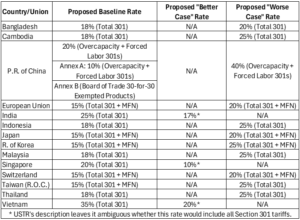
In terms of product coverage, USTR has formulated its proposal as covering all products of a given country, subject to specific product exclusions. At a high level, product exclusions generally reflect products that were excluded from coverage under the Forced Labor Investigation Section 301 tariffs for each respective country. For China, however, the generally applicable exclusions relate to certain products with limited domestic availability, as set forth in Annex A of the announcement, and USTR proposes a reduced rate (10%) rather than a complete exclusion.
Consistent with the Forced Labor Investigation tariffs and announced Agreements on Reciprocal Trade, many (but not all) countries would continue to enjoy country-specific product exclusions from the Section 301 tariffs. However, China’s country-specific product exclusions, listed in Annex B of the announcement, are unique in that they are explicitly tied to the U.S.-China Board of Trade’s 30-for-30 initiative. Notably, whereas USTR’s proposed “worse case” tariff rates generally are not coupled with a proposal to change which products are excluded from tariff coverage, that is not the case for China, which could, in theory, see the more favorable treatment for products in Annexes A and B rescinded.
Because the above represents proposals, all are subject to potential change and no firm date has been announced for implementation.
Stacking
As provided for in the announcement, it remains USTR’s intent that the Section 232 tariffs retain preferential status as the first tariff remedy, whereas Section 301 tariff policy acts as a backstop to address additional macro-economic concerns regarding forced labor and overcapacity. Specifically, if a good is subject to Section 232 remedies, it will not be subject to Section 301 remedies (either labor or overcapacity), with the exception of the original China Section 301 on intellectual property, which does stack on top of Section 232 measures. To be sure, MFN duties also stack on top of Section 232 measures, even though they may be treated differently in this most recent announcement for Section 301 purposes. For each of these tariff measures, antidumping duties, countervailing duties, and any tariffs imposed pursuant to Section 201 of the Trade Act of 1974 (the safeguard law), stack.
Evolving Policy
The Executive Branch has announced a variety of “actions” in recent months under the tariff statutes. Many such announcements have involved delayed implementation (e.g., Section 232 tariffs on polysilicon). Others have, at least temporarily, forgone tariffs entirely, in favor of negotiations (e.g., Section 232 investigation on industrial machinery). The Trump Administration has also extended its trade détente with China until January.
The net impact of USTR’s proposed tariff increase in connection with the Overcapacity Investigation is somewhat blunted by the continued product exclusions and the anti-stacking framework. Given the other possible scenarios and comparison to the since-vacated International Emergency Economic Powers Act tariffs of 2025, this can be understood as a less aggressive footing in tariff implementation. Whether that approach will hold remains to be seen into 2027, which is the earliest that these announced tariff measures could take effect.
Navigating a Shifting Tariff Landscape
The attorneys, licensed customs brokers, compliance professionals, economists, and trade specialists of Cassidy Levy Kent regularly assist companies in evaluating their supply chains to ensure compliant market access and adjust for tariff-related developments, including Section 301 tariffs, both mitigating burdens and taking advantage of opportunities. Businesses should be aware of the possible outcomes when planning or reviewing their supply chains.