
Yesterday, President Trump issued an Executive Order that aims to significantly alter who may import goods into the United States and how. The Executive Order lays out two goals:
- Increase the government’s ability to enforce Customs laws and regulations, and
- Increase the government’s visibility into the entities bringing goods into the United States.
It is unclear when the changes contemplated by this Executive Order will be implemented, as many of the provisions will require a change in regulation or legislation. We note, however, that changes in U.S. Customs and Border Protection (“CBP”) policy, such as the change to penalty mitigation, can be implemented immediately. The changes contemplated by the Executive Order are outlined below. We note that the Executive Order is long on proposed changes but short on details. We anticipate significant uncertainty as CBP seeks to adopt these changes.
New Requirements for Importers of Record
The Executive Order tasks the Department of Homeland Security (“DHS”) to revise the regulations, guidance, and policies governing Importers of Record (“IORs”). The revisions will:
- Require IORs to have at all times a minimum level of tangible domestic (U.S.) assets, customs bonds, or both, that is determined by CBP to be necessary;
- Increase the minimum required bond coverage for an IOR;
- Require filers of formal and informal entries to designate an IOR and a bond (or sufficient tangible domestic assets, or both);
- Require IORs to provide CBP with additional data and identification information, including anticipated import volumes, year organized, ownership and beneficial ownership disclosures, business affiliation disclosures, and domestic asset disclosures; and
- Require IORs to maintain “good standing” with CBP based on the IOR’s and its affiliates’ history of compliance, timely payment of customs liabilities, and other factors. An IOR that is not in “good standing” with CBP will not be allowed to import into the United States — full stop — and may not even designate a customs broker to import on their behalf. For example, IORs that have been found by CBP to have illegally imported fentanyl, nitazene, or other illicit substances or contraband, including precursor chemicals for the purposes of manufacturing illicit substances, will not be in “good standing” with CBP.
Different and More Stringent Treatment of Foreign Importers of Record
The Executive Order relies on national security interests to justify treating foreign IORs differently from U.S. IORs. The Executive Order sets out to prohibit foreign IORs from filing informal entries — meaning that even low-value shipments imported by foreign individuals and companies will require a formal entry. Generally, a formal entry requires an entry summary filing (CBP Form 7501) and other enhanced information declarations that informal entries do not. Moreover, foreign IORs will also be subject to heightened requirements for formal entry. A foreign IOR will no longer be able to rely upon a continuous bond to meet the formal entry filing requirements “unless CBP is satisfied that revenue will be fully protected,” which could be based on the amount of tangible domestic assets held by the entity or increased bonding requirements, or both. In addition, a foreign IOR would only have the right to file formal entry if it is validated in CBP’s voluntary Customs Trade Partnership Against Terrorism (“CTPAT”) program. Otherwise, the foreign IOR will need to use a CTPAT-validated and licensed customs broker to file entries with CBP.
“U.S. Importers of Record” vs “Foreign Importers of Record”
Under the Executive Order, an entity is considered a U.S. IOR if they meet one of two tests:
- The entity is:
- organized under the laws of the United States,
- has at all times controlling beneficial owner(s) who are United States citizens or lawful permanent residents, and
- is located in the United States (to be considered “located in the United States,” the Executive Order requires that the entity have its principal place of business in the United States, a physical presence where significant business activity is conducted in the United States, and sufficient tangible assets located in the United States); or
- The entity owns a significant amount of real property (e.g., real estate and physical structures) in the United States, as determined by DHS.
An entity would be considered a foreign IOR under the Executive Order if they do not meet the definition of U.S. IOR. In other words, a foreign IOR is any entity that does not meet one of the two tests set out above.
The Executive Order does not define “controlling beneficial owner(s),” nor does it contemplate ownership by entities such as parent corporations or holding companies. Without further clarity on the parameters of this requirement, it may be challenging for an entity to prove that United States citizens or lawful permanent residents are “controlling beneficial owner(s).” Similarly, it may be challenging to demonstrate that an entity owns a significant amount of real property unless or until “significant” is defined by DHS.
Increased Disclosure Requirements for IORs
The Executive Order calls for heightened import disclosure and certification requirements. New obligations for IORs include certifying compliance with critical supply chain requirements including the Countering America’s Adversaries through Sanctions Act (Public Law 115-44), 18 U.S.C. § 545, and others to be determined by CBP. IORs will also need to provide additional business identifiers, foreign tax information, and detailed supply chain data, including manufacturer product identifiers, and technical product specifications. Failure to comply could result in criminal fines and civil penalties. The Executive Order also tasks DHS to establish requirements for IORs to submit export documentation that foreign exporters were required to provide to their own customs authorities before shipment to the United States.
Expanded CBP Enforcement
The Executive Order calls for a significant expansion of customs enforcement efforts. The Executive Order calls for DHS and the Department of Justice to prioritize the enforcement of laws relating to misclassification, undervaluation, illegal transshipment, and forced labor. Per the Executive Order, CBP will pursue greater enforcement of liquidated damages claims, restrict in-bond movements, and increase audits.
The consequences for noncompliance will be increased as well. Historically, CBP has allowed significant reductions (e.g., 3-10 percent) of assessed penalties if a violator was able to show mitigating circumstances. The Executive Order requires DHS to revise mitigation standards to establish a minimum penalty floor of at least 50 percent of the assessed penalty, establish a minimum liquidated damages floor, and eliminate mitigation entirely for repeat offenders. The Executive Order pushes for maximum penalties for any Customs broker who fails to conduct due diligence, repeatedly represents non-compliant clients, or fails to cooperate timely with CBP requests. The Executive Order also directs DHS to streamline seizure and disposal procedures of non-compliant imported merchandise.
Proposed Legislative Action
Congress is already considering legislation that aligns with several goals of this Executive Order. The Senate and House of Representatives have introduced the Securing Accountability in Foreign Entries Act (S. 4003 and H.R. 7812), which would impose stricter requirements on foreign IORs and increase bond requirements, among other things. Prior to the Executive Order, there was little indication that this bill would advance out of committee to become law. That said, even with renewed attention resulting from this Executive Order, any resulting legislation could take months or even years to advance through Congress.
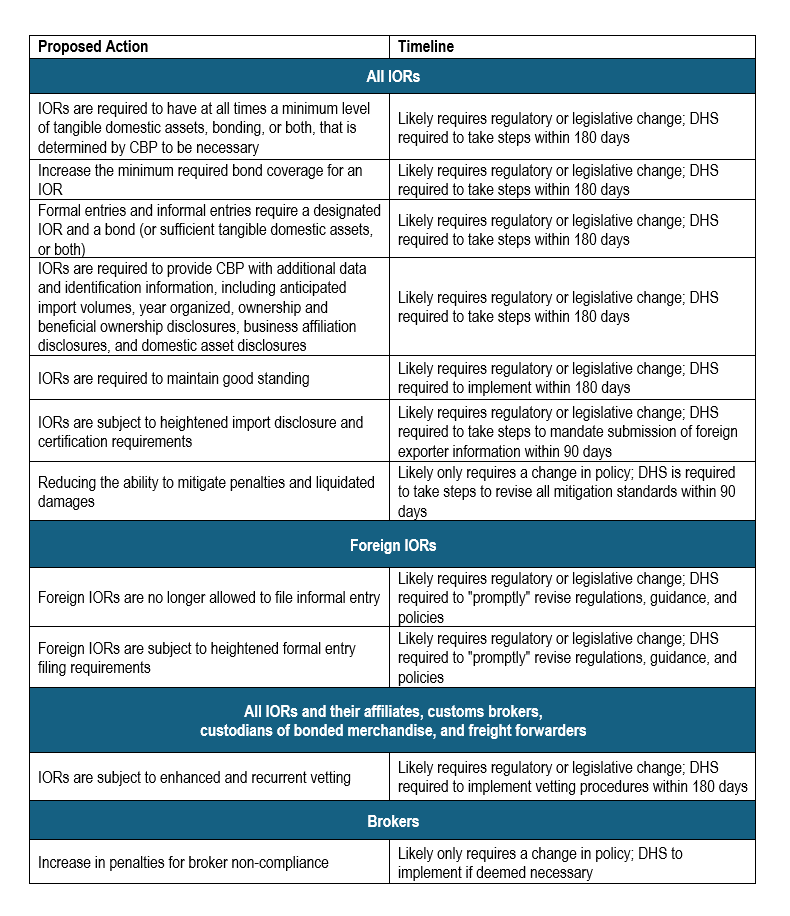
A summary of the proposed actions, the impacted parties, and estimated timelines is provided below.
In this dynamic regulatory landscape, Cassidy Levy Kent’s team of attorneys, licensed customs brokers, compliance experts, economists, and trade specialists stand ready to guide companies through complex entry procedures and tariff compliance. As companies navigate these evolving rules, thoughtful planning and careful evaluation of entry processes will be essential for long-term success.